Where Time Stands Still
Ancient Matopos and the Timeless Sanctuary of Amalinda Lodge
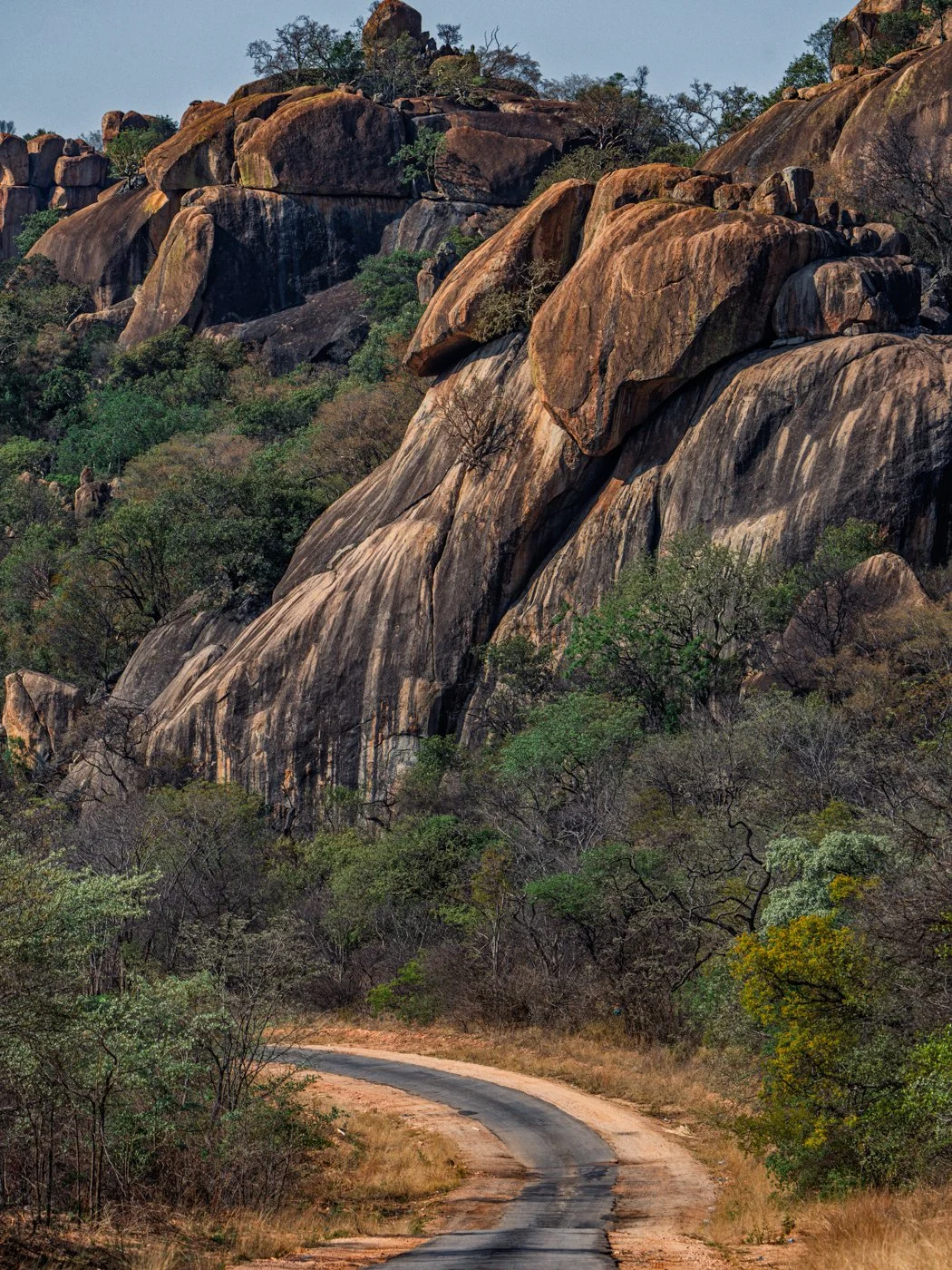
The granite beneath your feet is two billion years old. Let that settle for a moment. These rocks were ancient when the first complex life emerged in Earth's oceans. They were already impossibly old when dinosaurs walked the planet. And now, in Zimbabwe's Matobo Hills, they rise in impossible formations, massive whaleback domes and precariously balanced boulders that seem to defy physics, creating a landscape that feels less like Earth and more like a place where the ordinary rules simply don't apply.
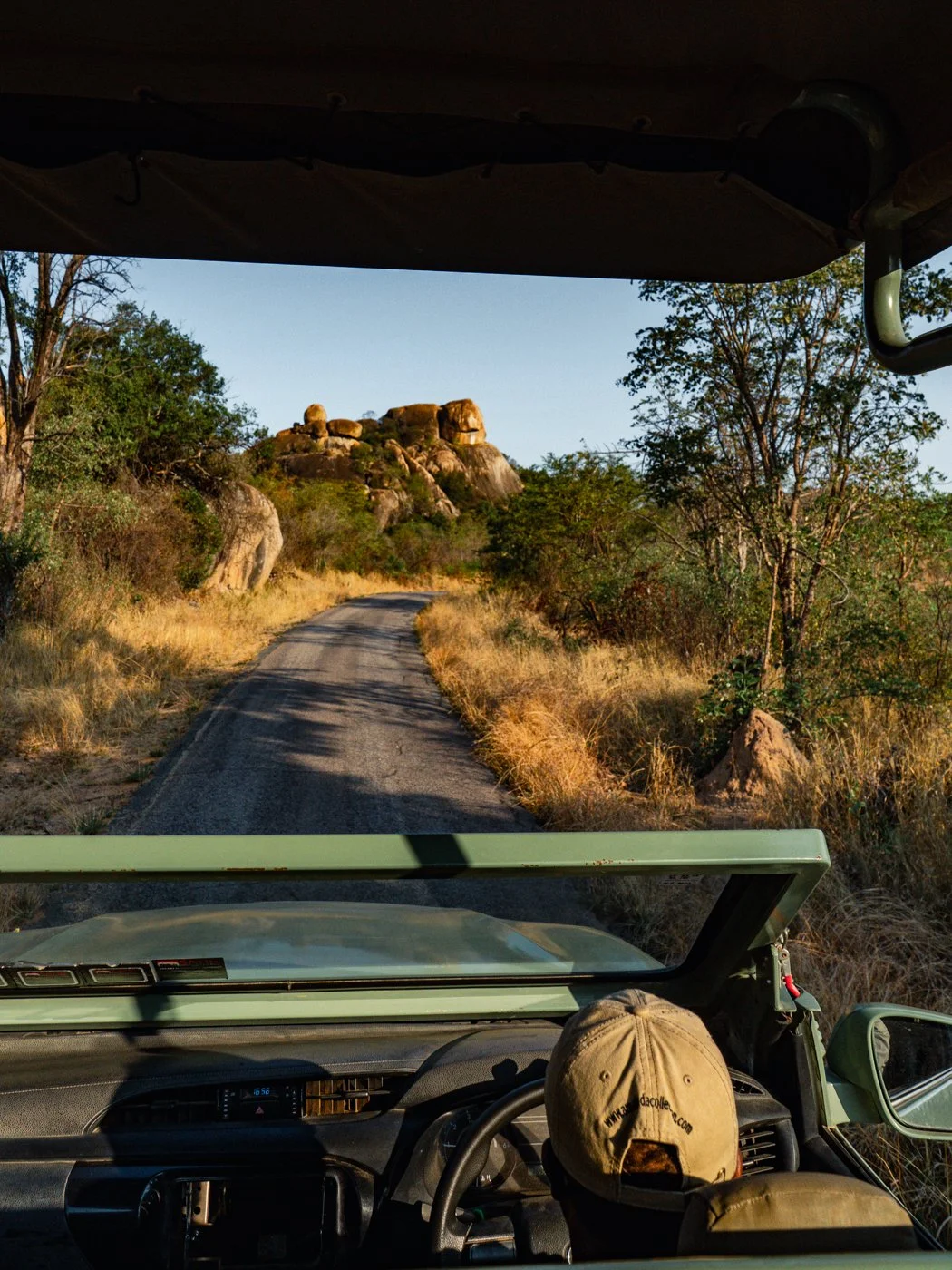
This is the setting for Amalinda Lodge, a property built quite literally into these primordial rocks in the heart of a UNESCO World Heritage Site. To stay here is to submerge yourself in a landscape that has witnessed the entire span of human history and prehistory, and to encounter some of the oldest creatures still walking the Earth.
Born of Fire, Sculpted by Time
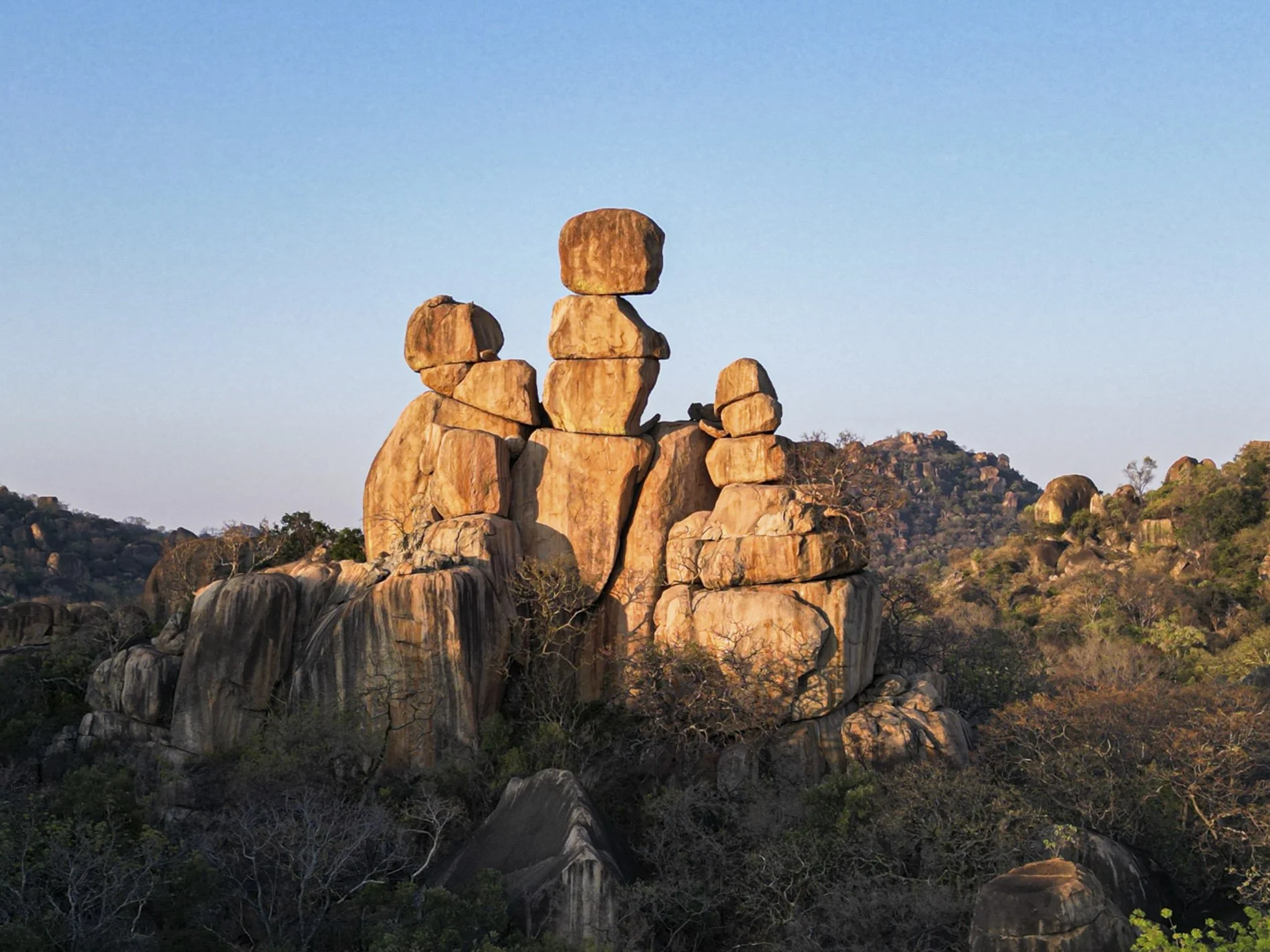
The Matobo Hills began as molten granite, forced upward through the Earth's crust during a period of intense volcanic activity two billion years ago. What visitors see today are the exposed batholiths, massive underground domes of solidified magma that once lay kilometres beneath the surface. Over countless millennia, the softer rock above eroded away, leaving behind these harder granite cores.
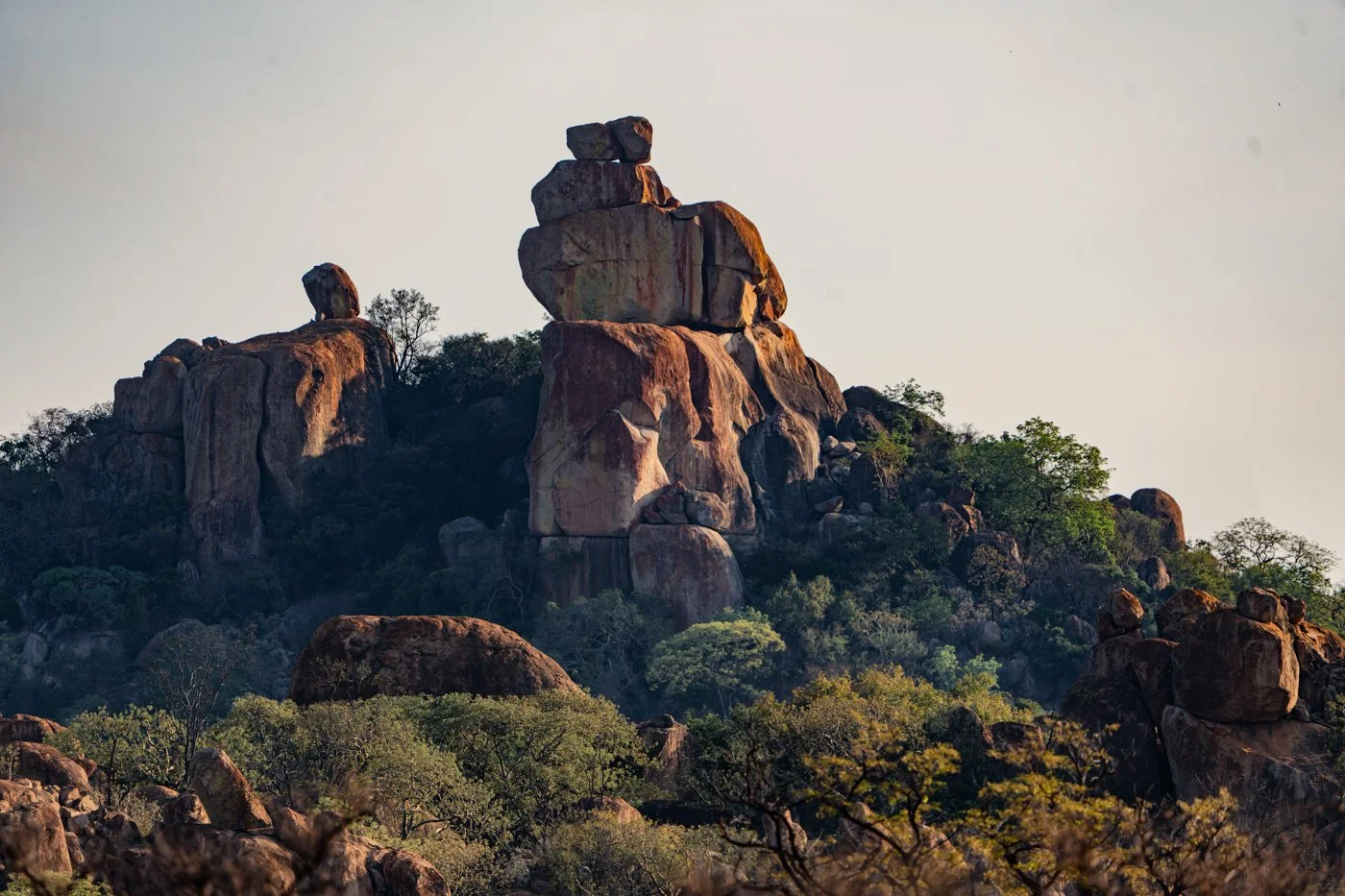
But time was not finished with its work. Wind, rain, and the relentless cycles of heating and cooling continued to shape the granite into the extraordinary formations visible today. The distinctive "whaleback dwalas," smooth, rounded hills that look like the backs of great sea creatures rising from the savannah, alternate with clusters of enormous balancing rocks, including the iconic Mother and Child Kopje. Between these granite mountains, narrow valleys have formed, creating microclimates that support over 200 species of trees and a remarkable diversity of wildlife.
The local Ndebele people gave this landscape its name: Matobo, meaning "bald heads," a reference to the smooth granite domes that characterize the terrain. It is a landscape that has, across millennia, inspired spiritual reverence. The Mwari religion, which may date back to the Iron Age, considers these hills sacred, the dwelling place of the High God, whose voice, according to tradition, once emanated from caves deep within the rocks. Specific hills, caves, and pools remain sites of pilgrimage and ceremony to this day.
Ancient Guardians of the Hills
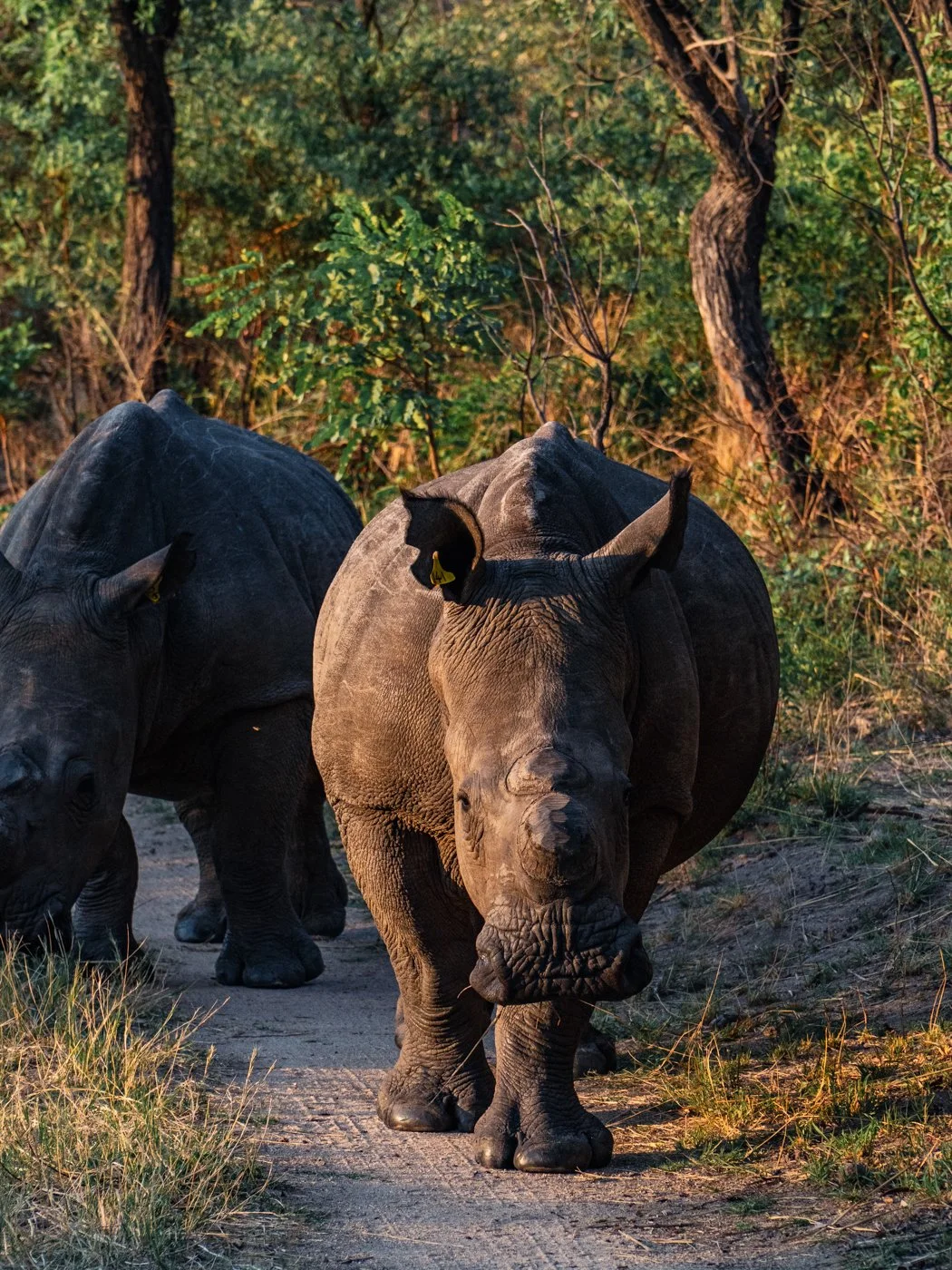
If the rocks of Matopos represent Earth's geological memory, the rhinos that roam these hills embody a different kind of ancient persistence. The rhinoceros lineage stretches back approximately 50 million years, when their earliest ancestors first appeared in what is now India. During the Oligocene epoch, some 34 million years ago, their relatives included Paraceratherium, a hornless giant that stood five metres at the shoulder and remains the largest land mammal ever to have lived. Through ice ages, mass extinctions, and the rise and fall of countless species, rhinos have endured.
Today, Matobo National Park serves as an Intensive Protection Zone for both black and white rhinoceros, giving the area one of the highest concentrations of rhinos in Zimbabwe. The population here has a complex history: white rhinos were reintroduced from KwaZulu-Natal, South Africa, in the 1960s, while black rhinos arrived from the Zambezi Valley during the 1990s. Both species now patrol these ancient hills, their survival a testament to decades of conservation work and vigilance against poaching.
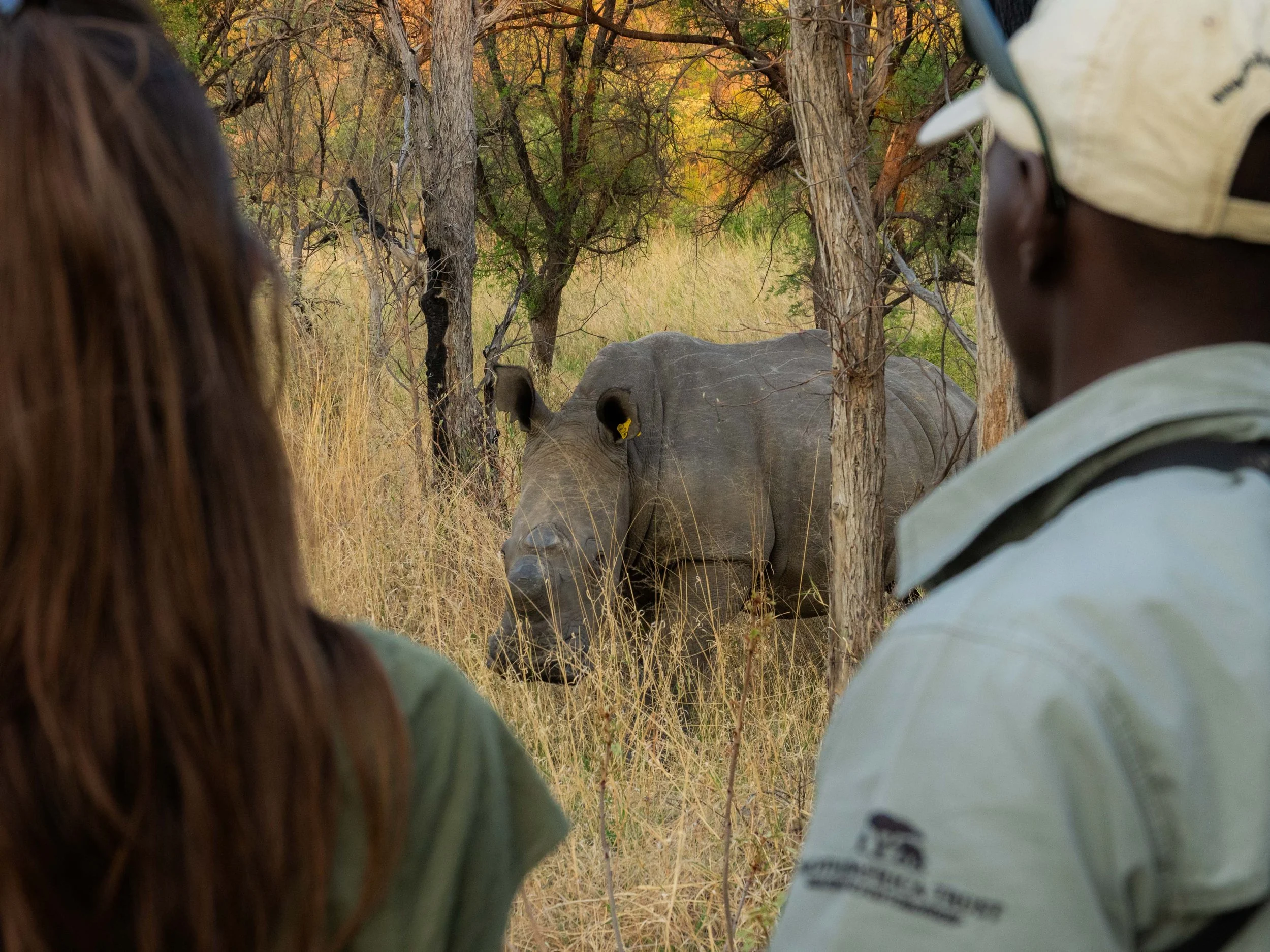
At Amalinda Lodge, tracking these prehistoric survivors on foot represents one of the signature experiences. Led by expert guides through the boulder-strewn terrain of the protected game area, visitors follow spoor, droppings, and subtle disturbances in the bush until, often with startling proximity, they find themselves in the presence of these massive, meditative creatures. The white rhinos, in particular, are grazers by nature, and watching them methodically crop grass while barely acknowledging human observers creates a sense of profound connection across evolutionary time.
There is something both grounding and expansive about standing fifteen feet from an animal whose ancestors walked the Earth when most of Africa was still forming. The experience transcends the typical wildlife encounter. It becomes, in its quiet way, a form of communion with deep time.
Echoes of the First People
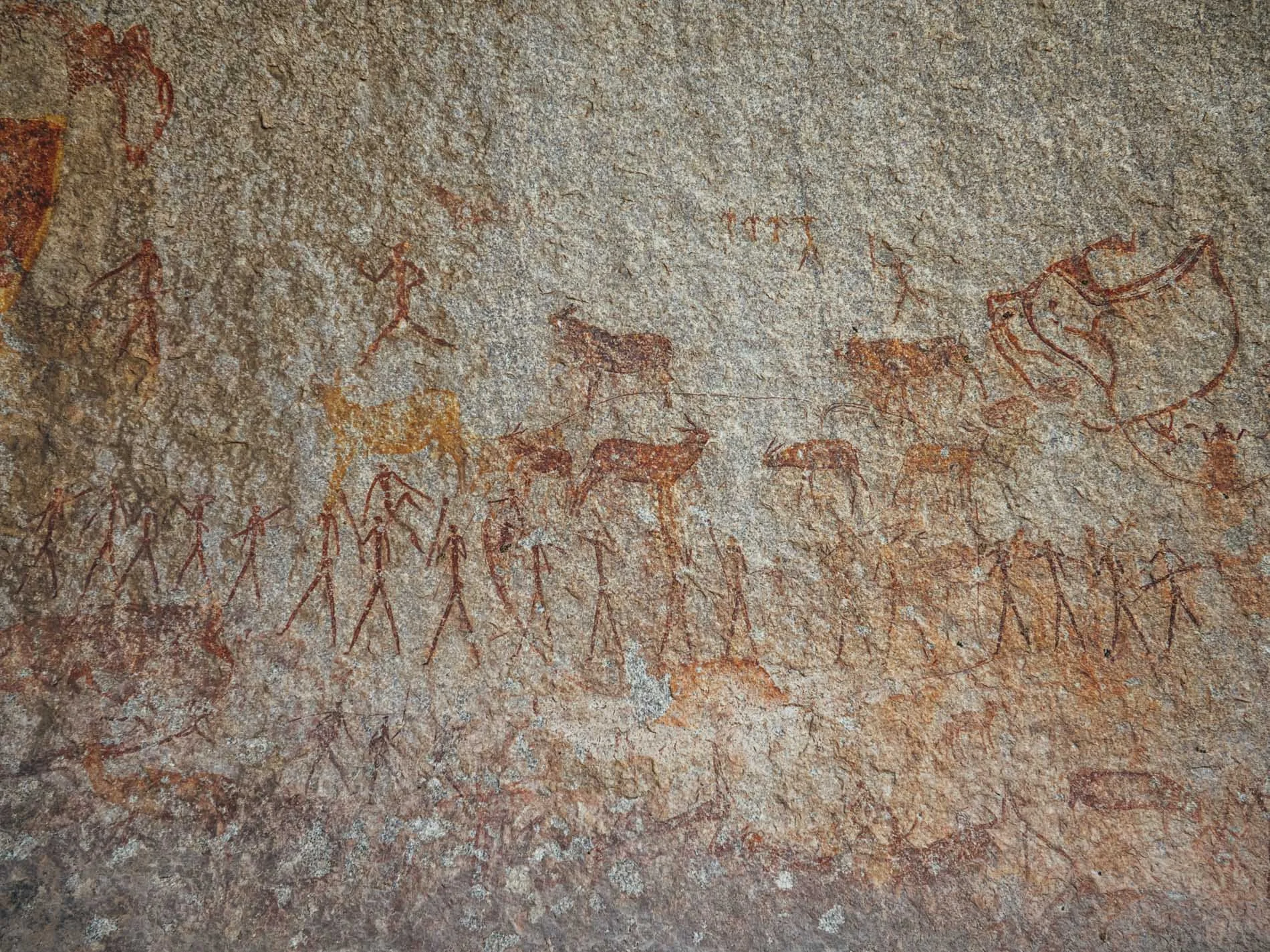
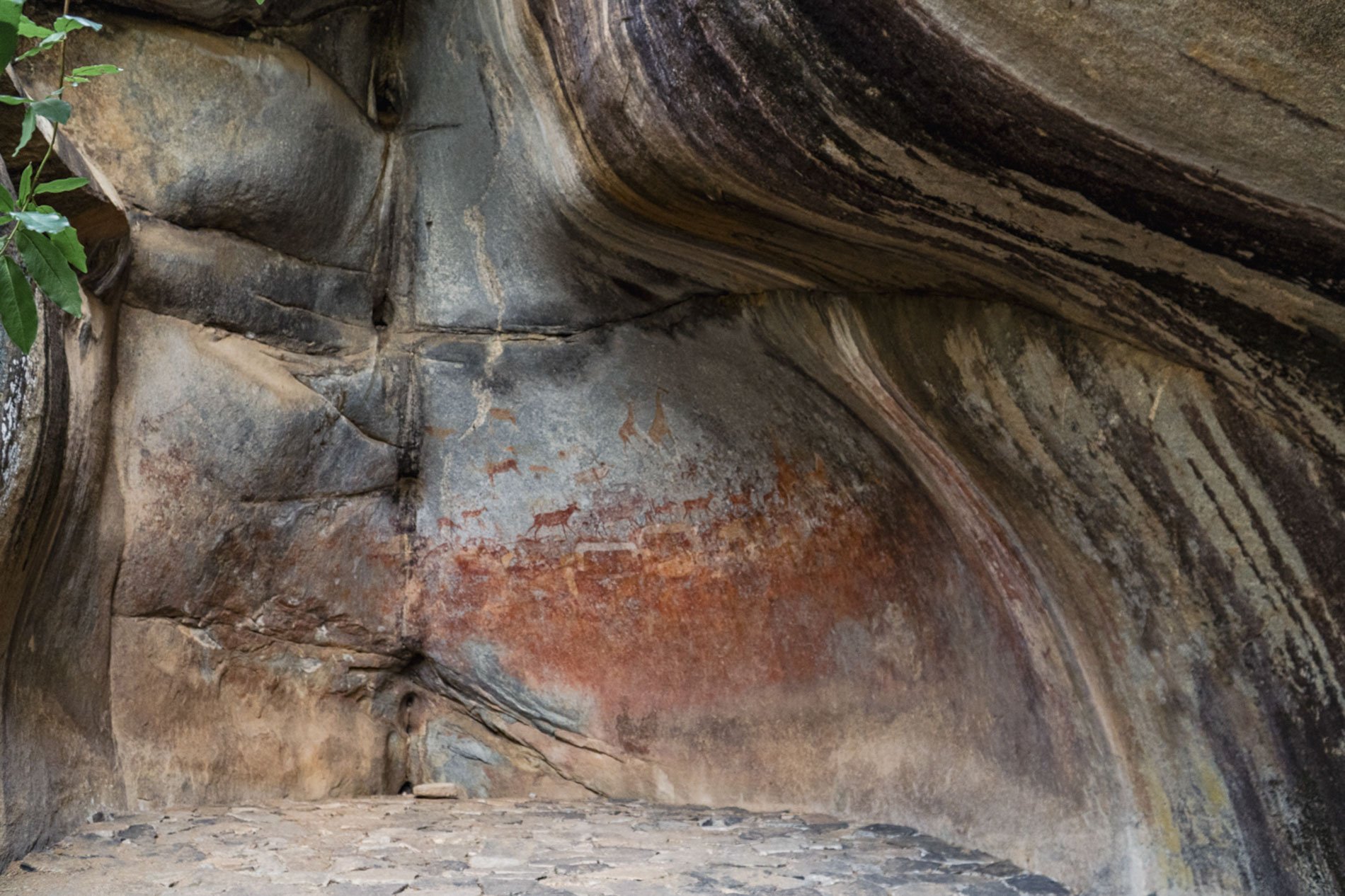
The San people, hunter-gatherers who inhabited these hills for thousands of years, left behind one of the most remarkable artistic legacies on the continent. Matobo contains over 3,000 registered rock art sites, representing one of the highest concentrations of prehistoric paintings in Southern Africa. Some of these works date back more than 13,000 years, though the tradition continued until the San were gradually displaced by Bantu-speaking peoples around 2,000 years ago.
These are not crude stick figures. The San paintings display a sophisticated understanding of animal anatomy and movement, rendered in rich ochres, reds, yellows, and whites made from crushed earth mixed with animal fat and plant binders. Giraffes appear with distinctive outline work and infilled bodies. Kudu, a species that doesn't naturally inhabit the immediate Matobo area but clearly held spiritual significance, feature prominently. Human figures dance, hunt, and gather in compositions that speak to both daily life and the trance states central to San spiritual practice.
At Amalinda Lodge, guided hikes through the granite formations lead to cave shelters where these paintings remain remarkably well preserved. The overhanging rocks have protected them from the elements, and the guides, many with archaeological training, provide context that transforms viewing into understanding. They explain the significance of the half-human, half-animal figures believed to represent shamans during healing ceremonies, and the spiritual beliefs that connected the San to this landscape.
The lodge itself maintains an intimate connection to this heritage. Room eight, tucked among the granite boulders, contains an original San rock painting on its walls, a quiet reminder that guests sleep in spaces that humans have sought shelter in for millennia.
Where Wilderness and Shelter Meet
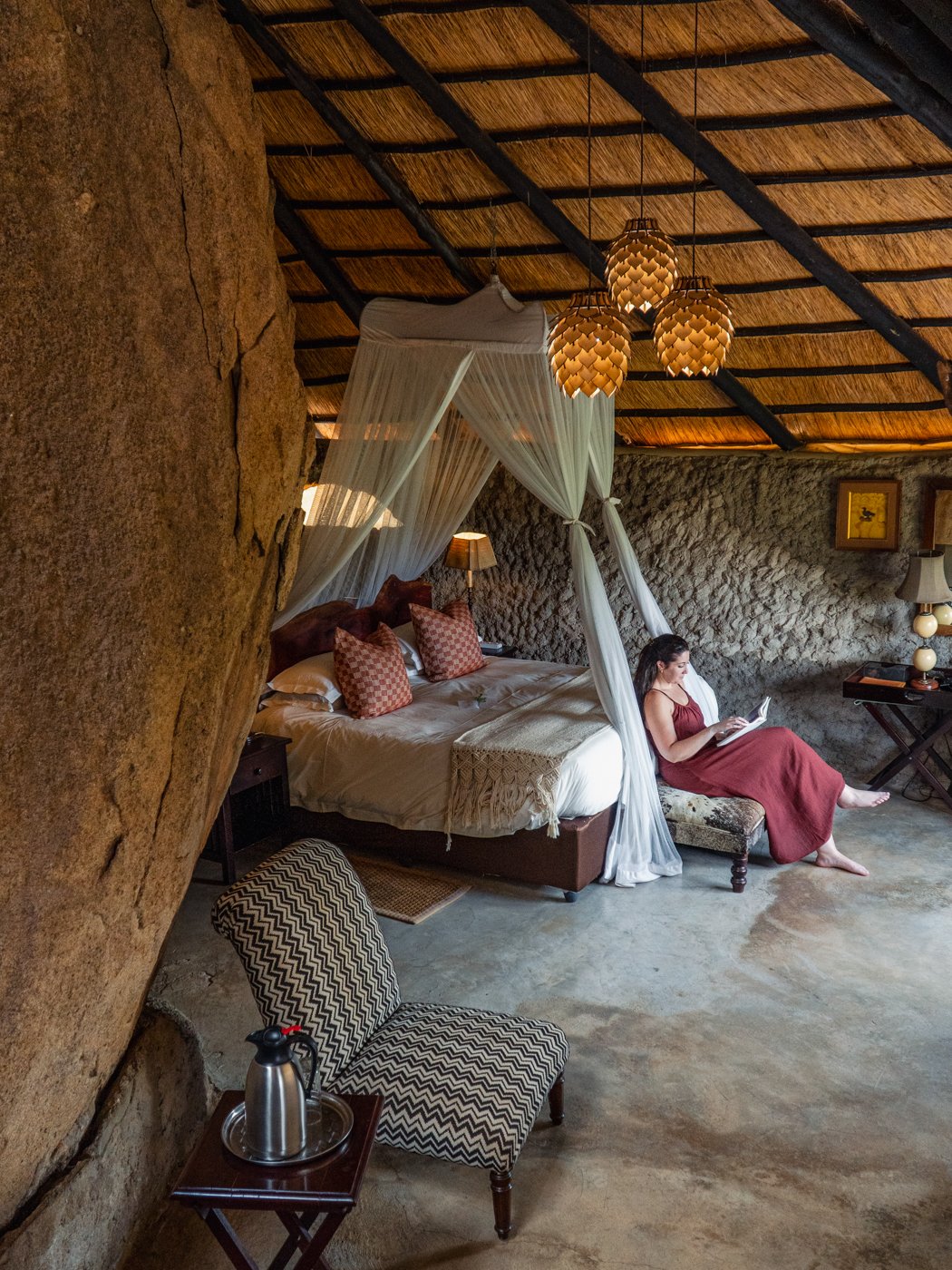
Amalinda Lodge grows from the landscape itself. The property's nine rooms are built into the granite formations, with massive boulder walls forming natural boundaries and ancient rock faces becoming interior features. The effect is something between architecture and geology, spaces where the distinction between shelter and wilderness intentionally blurs.
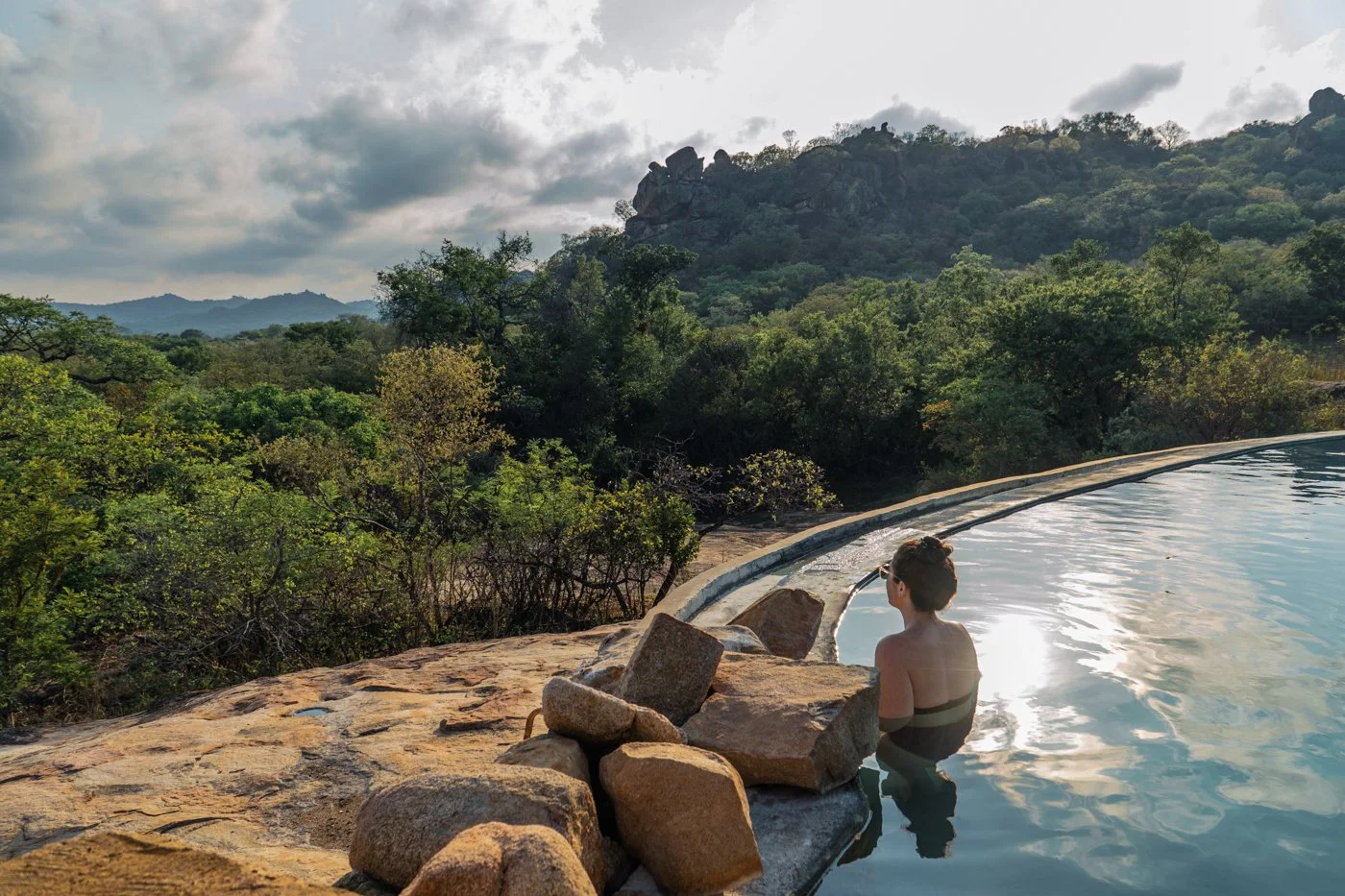
The communal areas continue this integration. The lounge and entertainment space occupies what was once a San shelter, offering panoramic views across the Matobo Hills. A library contains classic African literature. And at the base of the property, the famous swimming pool has been carved naturally over centuries by rain and wind erosion from a massive granite dome, an infinity-edge design that nature perfected long before architects discovered the concept. Floating in this pool, cocktail in hand, watching the sun set over rocks that predate complex life on Earth, represents a particular form of luxury: perspective.
The lodge's Safari Spa offers treatments that draw on this ancient energy. Whether the wellness benefits derive from the negative ions released by the granite, the profound silence of the bush, or simply the psychological effect of disconnecting from modern life in a landscape of such antiquity, guests consistently describe leaving Amalinda feeling restored in ways that extend beyond physical relaxation. There is a quality to this place, call it spiritual, call it geological, call it simply the effect of deep quiet, that recalibrates something fundamental.
A Heritage Protected
In 2003, the Matobo Hills received designation as a UNESCO World Heritage Site, recognition that this landscape holds Outstanding Universal Value for all humanity. The designation acknowledged multiple overlapping significances: the extraordinary granite landforms, the exceptional collection of rock art, the continuing spiritual traditions of local communities, and the area's importance as a refuge for endangered species.
For visitors, this designation means staying within a protected cultural landscape where conservation efforts balance the needs of wildlife, local communities, and the preservation of archaeological heritage. Matobo National Park, established in 1926, is Zimbabwe's oldest national park. The Intensive Protection Zone for rhinos represents some of the most intensive conservation work in the country. And the rock art sites remain under the stewardship of the National Museums and Monuments of Zimbabwe.
The lodge participates in this conservation ethic through the Mother Africa Trust, supporting community projects and wildlife protection efforts. Guests contribute to these initiatives through a nightly conservation levy, a small investment in ensuring that what exists here continues to exist.
Getting There: Through the Gateway of Bulawayo
Access to Matopos runs through Bulawayo, Zimbabwe's second-largest city and a destination with its own colonial-era architecture and cultural attractions worth exploring. Joshua Mqabuko Nkomo International Airport receives direct flights from Johannesburg daily via Airlink and Fastjet, a journey of just one hour and twenty minutes. Ethiopian Airlines connects Bulawayo to its global network through Addis Ababa, opening convenient routing options from Europe, the Middle East, and North America. Domestic flights link Bulawayo to Harare and Victoria Falls, making it easy to combine Matopos with Zimbabwe's other iconic destinations.
From Bulawayo, Amalinda Lodge lies approximately 45 kilometres south, a drive of less than an hour through increasingly dramatic scenery as the granite formations begin to rise from the surrounding plains. The lodge can arrange transfers, and the journey itself serves as preparation, the modern world gradually giving way to something far older.
The Gift of Deep Time
In an age of constant connectivity and accelerating change, Matopos offers something increasingly rare: a landscape that moves at geological speed. The rocks are not going anywhere. The rhinos have outlasted catastrophes we can barely imagine. The paintings on the cave walls have waited 13,000 years for visitors, and they can wait 13,000 more.
To spend time at Amalinda Lodge is to adjust, slowly, inevitably, to this different rhythm. The anxieties of contemporary life begin to seem appropriately small when viewed against two billion years of patient stone. The rhinos do not hurry. The eagles that nest in these hills, Matobo boasts the world's highest concentration of Verreaux's eagles, ride thermals with an ease that suggests time means little to them either.
There are places on Earth where history feels close. And then there are places where history feels almost irrelevant, where what matters is not the recent past but the vast, slow processes that shaped the planet itself. Matopos is the latter kind of place. And Amalinda, built into the very rocks that embody this deep time, offers perhaps the most meaningful way to experience it.
Come for the rhinos. Stay for the silence. Leave with something harder to name, a recalibration, perhaps, of what matters and what endures.